How kids are making thousands on baseball cards
The movers and shakers strolling through Rosemont aren’t your normal power brokers. Some still have braces. Others observe a strict bedtime.
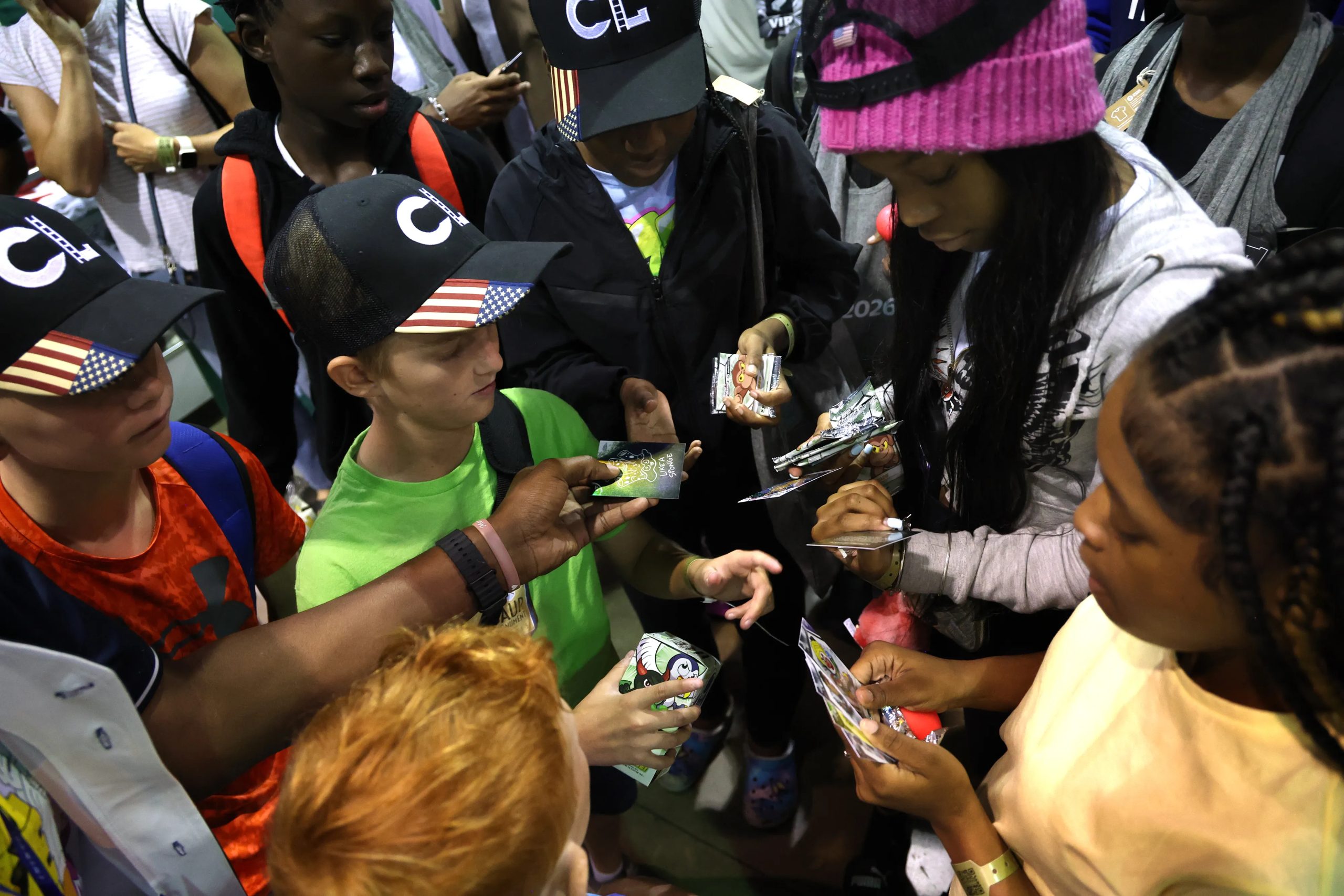
But don’t be fooled. The children working deals at this year’s National Sports Collectors Convention control inventories worth more than many adults earn in a year.
“Kids literally have a down payment on a house in their case,” said Zach Grygier, a 29-year-old sports card dealer. “They can’t even drive a car and they have a down payment on a house.”
The National returned to the northwest suburb last week, drawing hundreds of dealers and tens of thousands of collectors from across the country for five days of buying, selling and trading sports cards and memorabilia. It marked the convention’s 16th appearance in the Chicago area and its first consecutive return to the same venue in 43 years.
Amid the latest sports card boom, the industry is projected to grow from roughly $15 billion to more than $50 billion over the next decade. In a country packed with card shows, big and small, the National is both the Super Bowl and the World Cup of collecting.
Lines formed hours before the doors opened each day, with attendees stretching nearly a mile down North River Road. The crowd skewed younger than ever before, said Ronnie Holloway, a lifelong collector who owns sports card shops in North Center and Belmont Cragin.
“The pandemic brought a younger generation alive,” Holloway, 57, said. “You can compare the sports card industry to COVID-19 because that’s how fast it spread, and it just kept getting bigger and bigger and bigger.”
But this isn’t the hobby’s first boom. What began with children ripping open packs stuffed with stale sticks of gum had grown into a billion-dollar industry by the 1990s. Overproduction and loose licensing practices then gutted the market, slashing annual sales to the low millions and ushering in what collectors came to call the junk wax era.
Today’s resurgence has been fueled by companies like Fanatics and Panini, which emphasize scarcity and autograph inserts. Just this week, Topps, Fanatics’ flagship trading card brand, announced that a collector sold a newly pulled autographed Shohei Ohtani card for $11 million. That renewed interest has helped keep hobby shops in business, but much of today’s marketplace exists online, Holloway said, giving young collectors an advantage over older ones.
“The technology changed and kids changed with it,” said Holloway, who owns Elite Sports Cards and Comics. “They know they’re smart and they use their resources.”
The new generation moves billions of dollars through digital marketplaces, monitors real-time completed sales and tracks market databases throughout the day. They spend hours watching streams where influencers run “breaks,” ripping open boxes in real time for customers who paid in advance for a chance at the cards inside.
The results were evident across The National’s main hall, where children lugged heavy-duty cases filled with professionally authenticated cards. Some, like 12-year-old Cam Ruetz, who travelled from Wisconsin for the convention, estimated their collections were worth about $10,000.
Others were sitting, quite literally, on even bigger fortunes.
“I started when I was 5,” said JT Brown, a 15-year-old from Kentucky, perched atop a metal trunk containing a collection he valued at $1 million based on recent sales data.
Experts who study adolescent development aren’t surprised that children have embraced the industry’s shift. A hobby increasingly centered on social media and livestreams rewards skills many young people develop earlier and more naturally than adults.
“Kids are always the earliest adopters of new technologies,” said Ellen Wartella, professor emerita at Northwestern University. “They play at it, they engage with it and take chances that sometimes adults don’t want to take.”
Social media is where Nathan Massel, confined to his family’s North Center home during the pandemic, first noticed people flipping sports card boxes for double or triple their retail price. Soon, the middle-schooler was tracking down delivery schedules and lining up outside the Avondale Target to buy boxes he could resell to his local hobby shop or list on eBay.
“It was an easy way to make a profit,” said Massel, now 16. “There weren’t that many opportunities to make money as a 10-year-old, so it was pretty enticing.”
For the rest of lockdown, Massel was glued to livestreams where influencers explained how they bought and sold cards worth hundreds of thousands of dollars. Along the way, he learned the language of the hobby: “comp,” short for a comparable sale; “PC,” a collector’s personal collection; and “breaks,” livestreams where buyers purchase shares of sealed boxes that a host opens on camera.
Now, he buys cards for as much as $500, reselling them for hundreds of dollars in profit. He’s dabbled in streaming and considered opening a storefront on a popular online marketplace.
“His focus, his concentration and his ability to synthesize information is unbelievable,” Nathan’s father, Joel Massel, said. “His financial literacy right now exceeds that of the majority of adults you will ever meet.”
Massel is considering studying business in college and hopes to land a real estate internship next summer, though he’s keeping his options open. For now, he’s focused on selling cards, saying the skills he’s learned will carry into whatever comes next.
Zach Grygier, who started CompKiller Sports Cards in 2022, said those examples of industry success are important for kids growing up in an economy where many workers face job insecurity. Grygier left a career in sales to run the business full time, and he said his story shows young collectors it’s possible to make money off something they’re passionate about.
“There’s so many kids who look up to guys like myself,” said Grygier, who lives in Naperville. “You don’t need a degree in this world, and a lot of kids have so much drive cooped up that works so well in this industry.”
Over the past few years, Grygier has seen the same young faces pop up at card shows across the region. He’s watched middle schoolers grow collections worth hundreds of thousands of dollars, and now recognizes many of them as regular buyers on his livestreams.
Some older collectors, Grygier said, equate knowledge and sophistication with age. But just because someone has been collecting longer doesn’t mean they know more than someone studying twice as hard.
“The biggest misconception is that they can’t do exactly what we’re doing,” he said. “Kids are taking over this market and crushing it.”
-
Clark Calvin, 14, tosses some of his less valuable sports cards into the air in his bedroom on July 23, 2026, in Chicago. With the profits he makes, he reinvests them back into purchasing more cards. He also plays sports including baseball where he plays pitcher and first base.(Stacey Wescott/Chicago Tribune)


1 of 3
Clark Calvin, 14, tosses some of his less valuable sports cards into the air in his bedroom on July 23, 2026, in Chicago. With the profits he makes, he reinvests them back into purchasing more cards. He also plays sports including baseball where he plays pitcher and first base.(Stacey Wescott/Chicago Tribune)
Expand
‘They just want cash’
Clark Calvin waits by the front door for the mail carrier so his dog, Dude, doesn’t tear into the envelopes delivering his latest sports cards. With hundreds of sales under his belt, the 14-year-old runs his collecting business with practiced precision.
But he struggles to find other kids who care as much as he does about the players and teams on their cards. Too often, he said, the conversation begins and ends with what they’re worth.
“Most people are just trying to make money,” said Calvin, who lives in Lincoln Square. “They don’t even want to trade, they just want cash.”
It’s not surprising that Calvin’s peers are focused on the financial side of collecting, according to Wartella. Middle school is when many children first become interested in earning their own money and establishing independence from their parents, often forging new friendships and hobbies to support a newfound identity.
What’s changed, she said, is children’s unprecedented access to an industry that presents as a hobby but operates much like a financial market. From the moment they enter the world of collecting, they’re expected to understand buying seasons and know how to sniff out lousy deals.
With card prices increasingly speculative and online bidding so easy, experts have compared the risks to those accompanying the rise of legal sports betting platforms such as FanDuel and DraftKings. And children without deep pockets often find themselves priced out of the market or struggling to understand a steep financial loss.
“They’re too young and they’re definitely lacking in financial literacy,” said Michael Osacky, a professional memorabilia appraiser. “There’s a lot of hustlers out there, and it’s not an even playing field for kids.”
The sums of money children are working with are dramatically raising the stakes, said Osacky, who authenticates sports cards and memorabilia for a living. He regularly sees children arrive at card shows with collections worth hundreds of thousands of dollars, but for every successful young collector, many more are discovering just how unforgiving the hobby can be.
Sometimes it’s a bad deal, Osacky said, or an older collector taking advantage of a younger one. More often, though, it’s the volatility of the market where a blockbuster trade or season-ending injury can send collectors scrambling to sell before prices tumble.
A rookie card of New Orleans Pelicans forward Zion Williamson, the NBA’s 2019 No. 1 draft pick, once sold for thousands, but now goes for a few hundred dollars after repeated injuries limited his playing time. Tampa Bay Ray shortstop Wander Franco’s rookie card, a hot commodity after his 2023 All-Star season, plummeted when he was found guilty of sexually abusing a minor in the Dominican Republic.
“I had a Franco autograph and a few days after I got it he was convicted,” Calvin said. “Now, it’s like eight bucks.”
Holloway sees those losses firsthand at Elite Sports Cards and Comics, where he fields hundreds of calls each day from children desperate to sell their collections after losing money. Before the pandemic, he said, he got only a handful of such calls each week.
Kids walk in hoping there’s a way to recover what they lost. And Holloway said he can see it on their faces when they realize they’re not getting their money back.
“I hate to say it, but they were misled,” he said. “The bubble is going to pop, and I don’t think these kids can handle that.”
Holloway said he blames card manufacturers for transforming what was once an accessible hobby into a high-risk market driven by speculation. Top companies have secured exclusive licensing deals with major sports leagues, eliminating competition and driving up prices.
Today, Holloway said, the hobby has more in common with gambling than the joy of pulling a crisp Pete Crow-Armstrong. Opening a box can trigger the same dopamine rush as scratching a lottery ticket, he said, and livestreams that constantly showcase jackpot pulls only fuel the chase.
“They’re trying to get that high, and it’s out of control,” Holloway said. “They have to get their fix and make some money so they can go out and buy more.”
One major live-selling platform, Whatnot, reported more than $8 billion in gross merchandise value and more than 20 million created accounts last year. Calvin and Massel have both streamed on the platform, and Grygier sells hundreds of thousands of dollars in cards during multiple weekly broadcasts.
When customers ask Holloway why he doesn’t stream himself ripping the sealed boxes lining his shelves, his answer is simple: “Don’t get high on your own supply.”
Kids can become “obsessed” with technology when it’s introduced without meaningful safeguards, said Wartella, who has spent decades researching children’s media use. But she’s equally concerned by the lack of parental oversight as young people become more skilled at circumventing restrictions.
“There are real concerns of whether other people will take advantage of them,” she said.
Grygier said he’s watched adults exploit kids who lack the knowledge to spot unfair deals or negotiate effectively. Massel said some of his own friends have fallen victim to online scams, including one who shipped off his collection only to discover the buyer’s account was fake.
But the teenager has little sympathy. Losing, he said, is part of the hobby, and learning to separate emotion from profit comes with doing business.
“It’s definitely a way you can make a lot of money,” Massel said, “but I used to like collecting a lot more than I do now.”
‘More valuable than I thought’
As the premier trade show for a booming hobby, the National reflects both the opportunities and pitfalls of today’s sports card market. But amid the buying and selling, organizers also see it as a chance to introduce the hobby to children who might not otherwise have access.
That’s how Tamajae Banks, a teenager from the North Lawndale neighborhood, found himself watching major streaming hubs rip open cases on the convention floor Friday morning. Banks is one of dozens participating in the Youth Collectors Card Initiative, an educational program launched by the National Sports Collectors Convention to encourage responsible collecting.
“Trading is more valuable than I thought it was,” said Banks, 16, a student at The Collins Academy High School. “I knew adults were making money off of it, I just didn’t know kids could too.”
Earlier this month, Banks watched as Samuel Evans carefully sorted hundreds of packs of sports cards into neat piles. He stacked them atop blank notebooks and card price guides, materials Evans considers essential for his introductory collecting course.
The Philadelphia educator responsible for the YCCI curriculum is one of many collectors who see trading cards as a vehicle for financial literacy and entrepreneurship. Now, he’s trying to get those tools directly to children.
“I think it’s cool for kids to experience and learn those foundational entrepreneurial skills,” said Evans, 42. “We’re getting them to think about truly deepening the hobby’s reach in a meaningful way.”
The initiative got its start last year in Chicago, with back-to-back National Sports Collectors Conventions giving organizers a chance to build, test and refine the program. But it’s designed to be replicated in schools and events across the country, helping children build collections thoughtfully instead of getting swept up in the hobby’s increasingly speculative culture.
“We all play a role in how we shape what the rearing of a kid’s entrepreneurial growth looks like,” said Evans, known online as the Hobby Principal. “Let’s invest in this target market and create meaningful experiences.”


Evans taught the first part of the program at Curtis Granderson Stadium on the University of Illinois Chicago campus, where he drilled kids on calculating percentage gains and tracking card values. The second phase came at the convention itself, where his students walked the show floor to see the hobby in action.
Experiences like buying, selling and trading teach lessons that are difficult to replicate in a classroom, according to Karlyn Gorski, an assistant instructional professor at the University of Chicago who studies informal learning. Skills like negotiation, conflict resolution and time management, she said, are often best developed through experiences that extend beyond school.
Gorski said many students, including those with learning and developmental disabilities, can struggle to stay engaged in formal educational settings. So for those whose learning needs aren’t fully met at school, hobbies like collecting can provide an opportunity to build those academic and social skills.
“Kids don’t always get enough credit for how creatively they can find and access and put to use different forms of information,” she said. “In the age of the internet, we don’t see information restricted to coming from a teacher.”
Holloway learned to read from an Ernie Banks baseball card he found discarded in an alley, obsessively studying the Cubs legend’s statistics and biography until the words became familiar. Collecting became an antidote to his struggles in school, teaching him to calculate batting averages and strengthening his math skills along the way.
That lesson also resonates with Curtis Granderson, the Chicago native and three-time MLB All-Star who played for teams including the Detroit Tigers, New York Yankees and Los Angeles Dodgers. Watching Evans teach children about the collecting market, Granderson said the subject immediately captured their attention.
“Sometimes you just have to meet people where they are,” said Granderson, 45, who partnered with The National to launch the YCCI. “I feel like cards are a unique way to be able to do that.”
As they wound through the convention floor Friday, the children paused at displays of sports memorabilia. One marveled at a 1973 Topps wax box priced at $45,000, another lingered by a 1937 Lou Gehrig jersey listed for $3 million.
Stopping at Walmart’s booth, each kid took a turn pulling the lever on an oversize capsule vending machine. One by one, brightly colored spheres clattered into the tray, revealing plastic card protectors.
But when Banks twisted open his, he found a glimmering ticket redeemable for a premium hobby box from a nearby glass display.
“Anybody could have won, but it was me,” he said. “It’s kind of surprising, but mostly I feel lucky.”